How can AI handle inconsistent or messy bordereaux formats?
AI can interpret varied bordereaux layouts, column names and terminology by understanding the meaning of data rather than relying on fixed templates, significantly reducing the manual effort of standardising submissions. Human oversight remains essential to validate the results before they feed into underwriting or reporting systems.
Key takeaways
- Bordereaux inconsistency stems from the diversity of coverholders and MGAs, not poor practice alone.
- Traditional approaches rely on manual mapping or rigid templates that break when formats change.
- AI can interpret column meaning and structure even when formats vary, reducing repetitive manual mapping work.
- Human review remains necessary to validate transformed data and handle genuine ambiguity or errors.
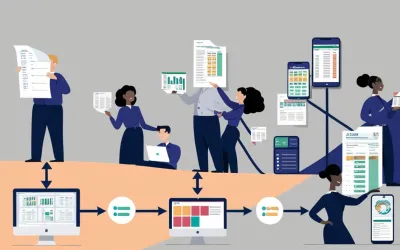
Delegated authority teams receive bordereaux from many coverholders and MGAs every reporting cycle, and almost none of them look the same.
Column names differ, structures differ, date formats differ, and the same business concept can be described in a dozen different ways depending on who submitted the file.
Standardising this information into a single usable structure, before any underwriting or oversight analysis can begin, is a persistent operational burden.
This article looks at why that inconsistency exists, how organisations have traditionally coped with it, and where AI genuinely changes what is operationally possible when transforming messy bordereaux into something consistent and usable.
Why bordereaux formats vary so much
Each coverholder or MGA typically builds its bordereaux around its own internal systems, regional conventions and product lines.
A coverholder in one territory may report dates in day-month-year format, while another uses month-day-year. One may report premium in local currency, another in the binder's base currency. Column headers reflect whatever terminology is standard in that organisation, so Policy Number, Certificate Ref and Contract ID might all refer to the same field.
This is a structural feature of how delegated authority works, not simply a sign of poor data discipline. Coverholders operate independently, often across different markets and systems, and a bordereaux is ultimately shaped by whatever produced it.
The result is that no two submissions can be assumed to share a layout, even when they describe identical business concepts.
Traditional approaches to standardising bordereaux
Operations teams have long managed this problem through manual mapping, fixed templates and, in some cases, outsourced data entry.
Manual mapping involves someone reviewing each submission and manually aligning columns to a standard structure. This works but does not scale well once the number of coverholders grows into the dozens or hundreds.
Fixed templates attempt to solve this by asking coverholders to submit data in a prescribed format. This reduces variation in principle, but in practice coverholders often deviate from the template, submit legacy formats, or introduce new products that do not fit the existing structure. Every deviation typically requires someone to update the mapping rules before the data can be processed.
Outsourcing data entry to a third party shifts the manual effort elsewhere but does not remove it. The underlying problem, that formats vary and someone has to interpret them, remains.
Where AI helps interpret messy bordereaux
AI models approach this differently by interpreting the meaning of the data rather than matching it against a fixed template.
Rather than requiring an exact column name match, AI can recognise that GWP, Gross Written Premium and Premium Amount likely refer to the same underlying concept, based on context such as surrounding columns, data patterns and typical bordereaux structures.
This allows AI to adapt to variation in layout and terminology without needing a new template built and maintained for every coverholder. When a coverholder changes their spreadsheet format, or a new coverholder is onboarded, the transformation process does not necessarily need to be rebuilt from scratch.
This changes what is operationally achievable at scale. Instead of maintaining a growing library of coverholder-specific templates, operations teams can rely on AI to handle the initial interpretation across a much wider range of formats, reserving human attention for genuine exceptions.
What to consider when relying on AI for transformation
AI-based transformation reduces manual effort, but it does not remove the need for oversight.
Organisations should still validate transformed data before it feeds into underwriting or reporting systems, particularly where the source data was ambiguous or the AI's confidence in a mapping was low.
A clear audit trail from the original bordereaux submission through to the transformed output remains important, both for internal quality control and for demonstrating how figures were derived if questioned later.
It is also worth recognising that inconsistent or genuinely poor-quality source data can still produce transformation errors. AI can interpret structure and terminology, but it cannot resolve missing information or correct fundamentally wrong data. That still requires a human decision.
Example
A London market managing agent receives monthly bordereaux from a dozen coverholders covering marine cargo risks across several territories. Each coverholder submits data in a different spreadsheet layout, with varying column names and date formats.
The operations team uses AI to interpret and transform each submission into the agent's standard structure, then reviews the output before it is loaded into the underwriting system.
The AI-based transformation reduces the time spent manually mapping each coverholder's format, allowing the operations analyst to focus on reviewing flagged inconsistencies rather than re-keying data from scratch.
FAQs
-
Can AI handle bordereaux with completely different layouts each month?
Yes, to a significant extent. AI models interpret the structure and meaning of data rather than relying on a fixed layout, so they can adapt to varying submissions more readily than template-based approaches. Review of the output remains important, particularly for low-confidence mappings.
-
Does AI eliminate the need for a standard bordereaux template?
No. Standard templates remain useful for guiding coverholders toward consistent reporting. AI reduces the operational impact when submissions deviate from that template, rather than removing the value of having one.
-
How much manual review is still needed after AI transforms bordereaux data?
Human review remains necessary to validate transformed output, resolve genuine ambiguities and confirm accuracy before the data is used for underwriting or reporting. AI reduces the volume of repetitive manual mapping, not the need for oversight.