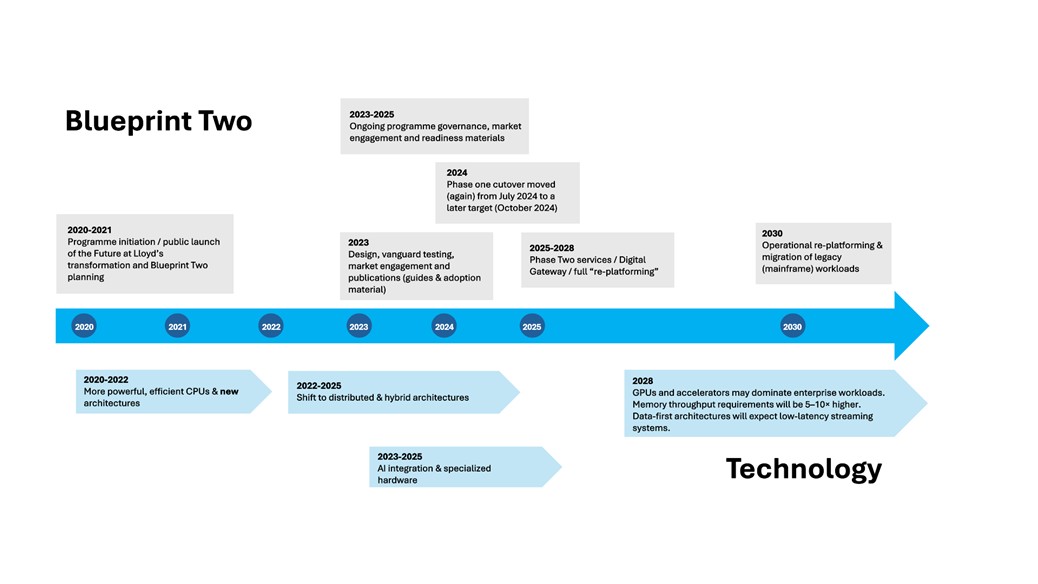
The Blueprint Two programme began in 2020. Since then, technology has moved forward at an exceptional pace and that pace is expected to increase even further after 2025. What were once seen as future technologies are now becoming standard for large organisations.
Powerful AI-ready systems, faster ways of processing data and a mix of on-site and cloud-based IT are no longer optional or experimental they are increasingly the norm. Major technology companies release new generations of hardware every year and many organisations are changing how their systems are designed and run.
As a result, there is a growing risk that Blueprint Two is being built for a technology landscape that no longer exists. By the time Blueprint Two is fully delivered, parts of the underlying technology are likely to already be outdated and require upgrading or replacement.
This creates a key challenge: can Blueprint Two continue to be delivered exactly as originally designed, or does it need to be updated to reflect how quickly technology has moved on?
The issue is not that the vision behind Blueprint Two is wrong. The risk is that, without adjusting its scope and assumptions, the programme may inherit problems from day one needing further modernisation almost immediately after delivery because the world has changed faster than the programme’s timeline.
The technology world has moved on much faster than the original Blueprint Two designs anticipated
When Blueprint Two was planned in 2020–2021, artificial intelligence (AI) existed, but it was mostly hidden behind the scenes and used in very specific technical products, such as image or speech recognition. In insurance, AI was not a core part of everyday operations and was not a major consideration in platform design.
By 2025, AI has become a core part of everyday operations rather than an optional add-on. It now reads and sorts documents, checks and validates information, supports underwriting and risk decisions, and automates large parts of processing. Because Blueprint Two was designed before this shift, there is a risk it does not fully support how modern systems now work, which increasingly require faster and larger data flows, specialist processing capabilities, near-real-time responses, and seamless collaboration between people and AI as part of normal business processes.
Blueprint Two was designed primarily as a digital transaction platform a way to move and process information more efficiently. However, the wider market is moving beyond this model toward intelligent data ecosystems, where systems continuously analyse, learn and assist decision-making.
At the same time, enterprise technology itself has become more complex and varied. Blueprint Two assumed a more uniform, centralised technology environment. Organisations now use a mix of different systems and environments, each suited to different types of work. Data is processed in more places, in more flexible ways and at greater speed.
While a central platform can still play an important role, it must be able to work across many different types of technology environments. Designs that assume a single, standard approach are increasingly hard to sustain.
There is also the challenge of timing. Blueprint Two’s core technology choices were made several years ago. By the time the programme is fully delivered potentially as late as 2028 it will be entering a technology landscape shaped by newer generations of systems that were not anticipated during the original design phase.
This creates a clear risk: technology decisions made early in the programme may already be outdated by the time Blueprint Two goes live.
If the programme continues without revisiting these assumptions, Blueprint Two risks building in problems from the start not because the idea is wrong, but because it was designed for a world that no longer exists.
Contact us if you’d like expert guidance tailored to your organisation, Wisereach can help you get there.
Or take a look at how we are helping speciality insurance modernise operational process and technology here