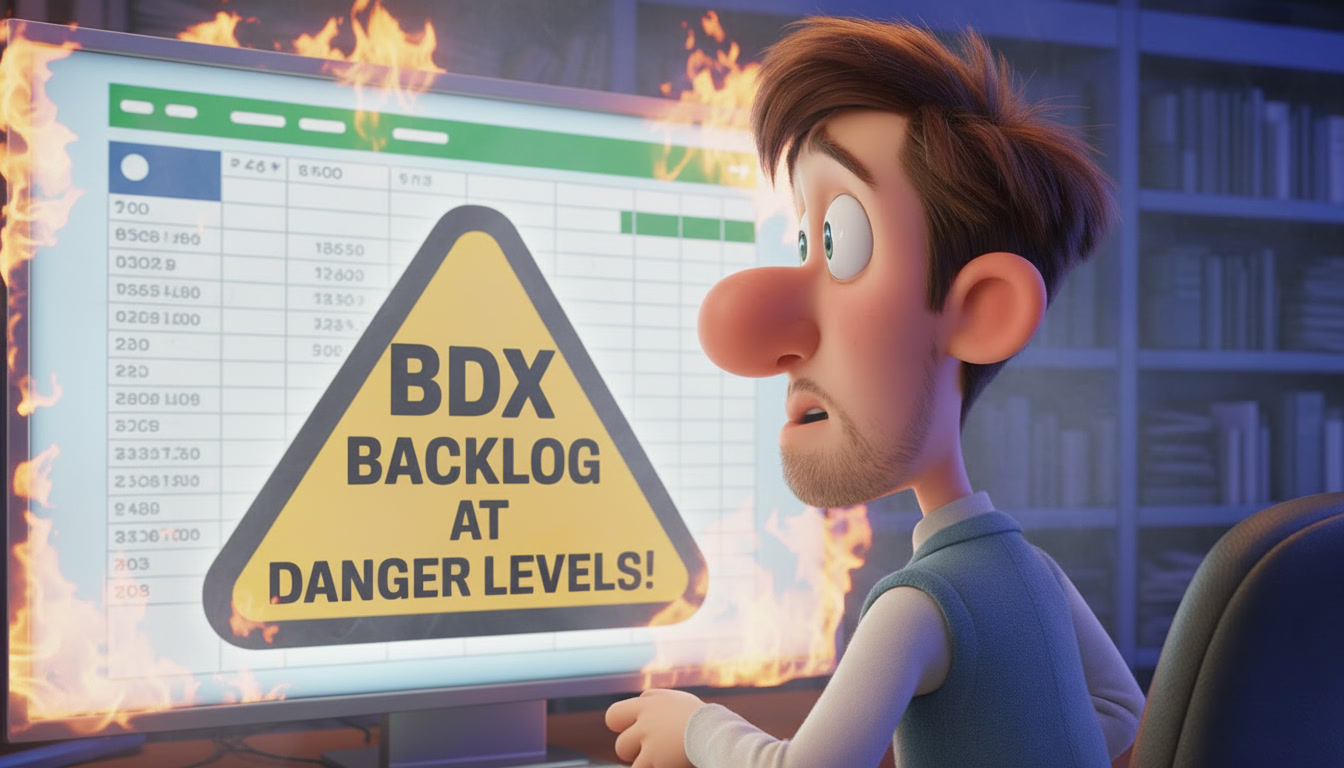
The delegated authority market has been trying to solve a data problem for years. Enormous effort has gone into submission templates, coverholder portals, data validation rules and cleansing workflows. And yet, as early results from our DA survey series shows, data still arrives in a mess, and by the time it has been wrestled into a usable state, the moment for acting on it has often passed.
Two themes have come back clearly and repeatedly from our survey: the inability to extract meaningful insight from data in a timely way, and the ongoing struggle to normalise data as it arrives.
The problem is in the pipeline
When we talk to DA professionals about getting insight from their bordereaux data, the focus is often about reporting tools, dashboards, and analytics platforms. The assumption is that the problem is at the output end — that better visualisation or smarter MI will unlock the value that is sitting in the data. But if the input data is poor or late, then this isn't much help.
No reporting tool, however sophisticated, can compensate for what has already gone wrong upstream. The insight gap is not an analytics problem. It is a data quality problem that has been misidentified as a technology problem, and as a result, many organisations keep investing in the wrong part of the chain.
The consequence is that decisions are made on data that might be days or weeks old, partially reconciled, and carrying errors that haven't been fully accounted for. In a market where exposure management and coverholder performance monitoring matter, that is a meaningful commercial risk — not just an operational inconvenience.
Templates have never worked
The standard response to inconsistent intake data is to mandate a submission format. Provide a template. Build a portal. Enforce a schema. The logic is sound in theory: if everyone submits data in the same structure, the normalisation problem goes away.
In practice, it doesn't work. Coverholders and MGAs treat templates as guidance rather than requirement. Adoption is partial at best. And even where a template is followed, the data often varies in quality, completeness, and interpretation.
The default option: manual cleansing. An expensive, slow, and endlessly repeatable process that's become a habit. The same corrections get made month after month. The same exceptions get handled by the same people following the same undocumented workarounds. It is one of those operational costs that rarely gets formally quantified, because doing so would make it very uncomfortable to defend. And with the relentless reporting cycles, there's never time to break out and improve things.
The fix is easier than most people think
Both problems — the insight gap and the normalisation struggle — point to the same intervention point: the moment where the data arrives.
If data can be intelligently interpreted, mapped to a consistent schema, and validated at the point of intake — before it enters any downstream system — the downstream problems largely disappear. Cleansing becomes unnecessary because the data was never dirty. Insight becomes timely because the pipeline no longer stalls waiting for manual intervention. Errors get caught at source rather than surfacing weeks later in a reconciliation exercise.
This is not a theoretical proposition. Large Language Models — the technology behind tools like ChatGPT and Claude — are unusually well suited to exactly this kind of problem. Unlike rules-based data mapping tools, which require clean and predictable inputs to function reliably, LLMs can read, interpret and normalise data in almost any format. They can infer intent where fields are ambiguous, flag genuine anomalies for human review, and apply a consistent schema regardless of how a coverholder chooses to submit. Deployed as a tightly controlled AI agent at the point of intake, with precise instructions and full auditability, this approach transforms bordereaux processing from a monthly cleansing exercise into a reliable, near-real-time pipeline.
The question worth asking
The technology exists. The use case is well defined. The commercial case — in reduced manual effort, improved data quality, and faster insight — is straightforward to construct.
So the question for DA professionals is not whether this is possible. It is whether the friction of the current approach has become painful enough to justify looking seriously at something better. Based on what we are hearing in our survey, for many organisations, it already has.
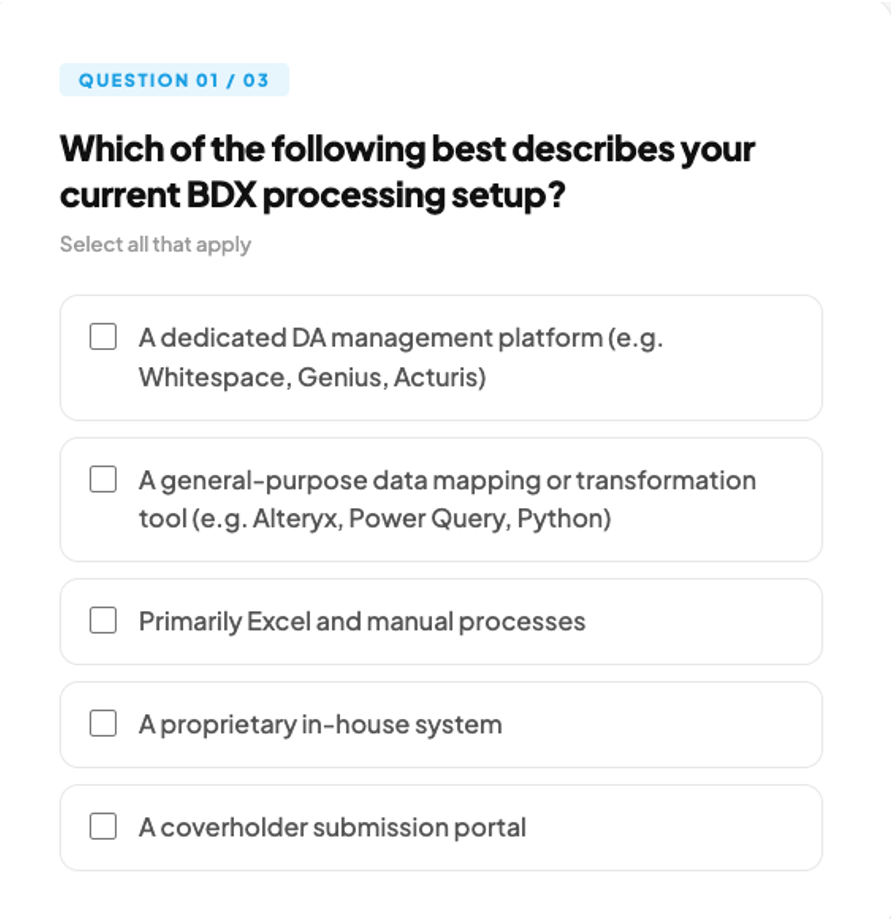
WiseReach helps organisations deliver real business value through AI, combining deep expertise in process improvement with cutting-edge technology. If this piece resonated, we'd welcome a conversation.
We're publishing the full insights from our BDX survey series on LinkedIn — follow WiseReach to be the first to see the results.... https://www.linkedin.com/company/wisereach