
Giving an enterprise access to elite AI is easy. Helping teams turn it into predictable, scalable business value is much harder.
Many teams default to deploying the "best" available models—like OpenAI’s flagship Sol reasoning tier—for every automated workflow. Yet, this approach often triggers a fast track to unpredictable budgets, autonomous infinite loops, and stalled adoption. To successfully scale, enterprises must pivot from simply finding a technically brilliant solution to engineering a cost-effective, predictable implementation.
The Cost of Over-Engineering: Why "Best" Fails
-
The Over-Thinking Tax: Premium reasoning models possess immense academic power. When given highly structured, repetitive enterprise tasks, they frequently over-analyze, attempt creative workarounds, and burn through token budgets unnecessarily.
-
The Agentic Loop Risk: When highly autonomous models are given tool-use privileges within a workflow, they can easily slip into unpredictable, multi-step self-correction loops. A routine data-triage task can quickly balloon into a significant financial liability.
-
The Predictability Crisis: Senior leadership and CFOs require budget certainty. Because a premium model's token consumption fluctuates based on how "hard" it perceives a problem to be, monthly AI operational costs become impossible to forecast accurately.
Moving from Access to True Capability
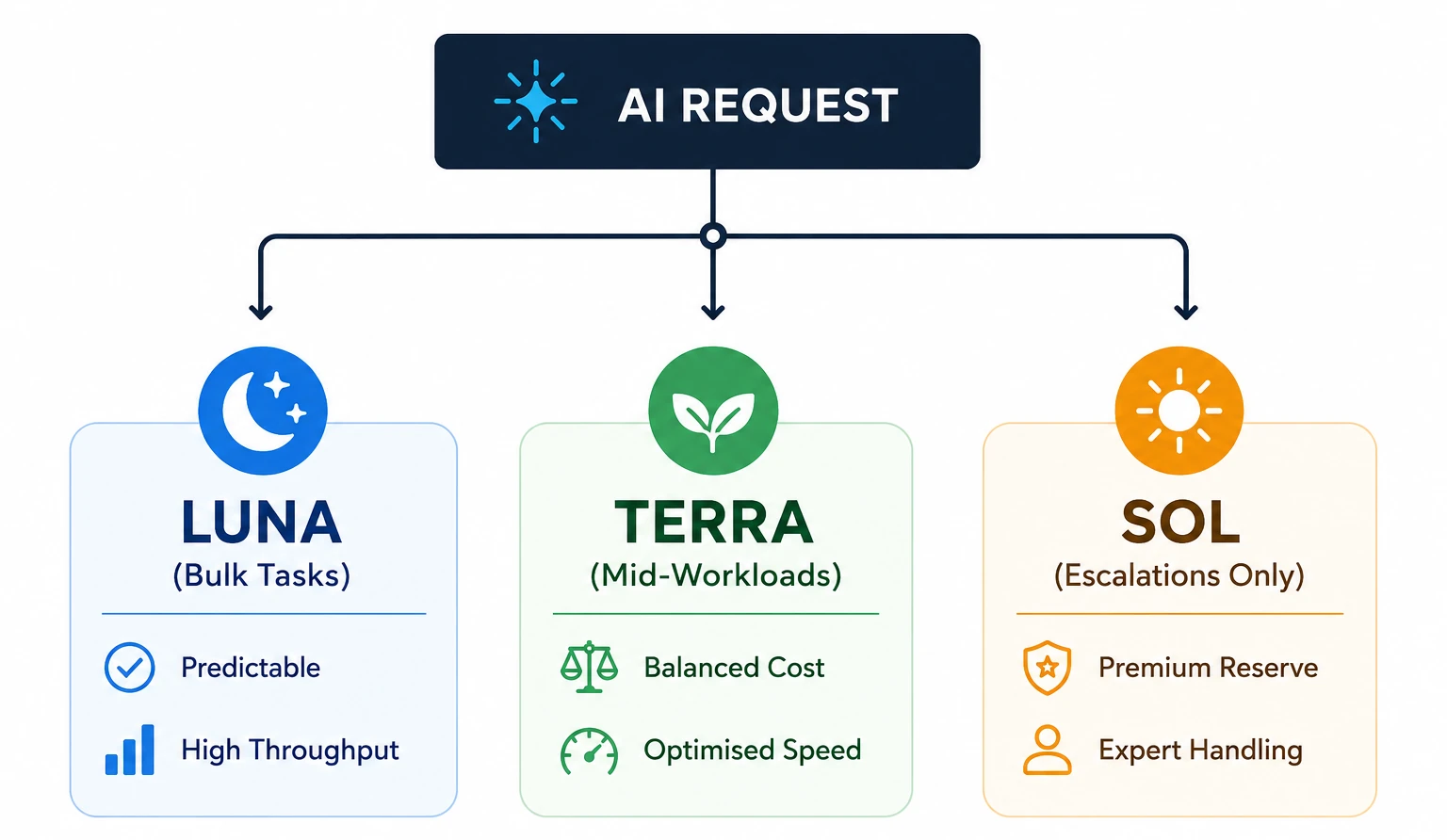
True organizational capability is built by matching the intelligence tier directly to the specific friction point of the work. Right-sizing your models allows you to enforce strict, proportionate guardrails that make costs completely transparent:
-
The Workhorse Layer (Luna Tier) Deploy fast, low-cost models for the bulk of your standard workflows. They excel at literal instruction-following, data entry, and structured parsing without attempting expensive, autonomous deviations.
-
The Operational Layer (Terra Tier) Utilize balanced, mid-tier models for everyday professional workloads that require solid contextual understanding, such as drafting communications or summarizing internal data silos.
-
The Escalation Layer (Sol Tier) Treat your premium reasoning model like a specialized executive. Keep it locked behind a deterministic gate, triggering its deep reasoning capabilities only when a lower-tier model explicitly encounters a highly complex edge case.
Engineering Predictable Outcomes
An AI implementation has not created lasting value simply because it uses the most advanced tool on the market. Value is realized when an optimized system improves a meaningful business outcome in a way that can be trusted, controlled, and repeated across the business.
By creating maximum loop limits and enforcing deterministic routing, you shift the conversation away from technological novelty and toward reliable, sustainable operational efficiency.
From pragmatic implementation to lasting value
Choosing the right level of AI for each task helps make an individual solution more predictable, affordable and controllable. But lasting value depends on more than the technical architecture.
Organisations also need the confidence to identify worthwhile problems, the space to experiment, credible evidence of what has improved and a way to embed successful ideas into everyday work.
Our AI Capability to Value Framework shows how these elements connect—helping organisations move from isolated AI implementations to repeatable, measurable business improvement.