
AI value starts with people
Giving people access to AI is easy. Helping them use it to improve real work is harder.
Many organisations have introduced AI tools and basic training. Their people may understand what AI is, know how to write a prompt and use it for occasional productivity tasks.
But access is not adoption. Training is not capability. And personal use does not automatically become organisational value.
People still struggle to recognise where AI could help, frame useful problems and experiment with better ways of working. Promising ideas remain isolated. Success is measured through licences, training and estimated hours saved, while the wider opportunity remains undiscovered.
the gap between access and capability
The people closest to the work understand its frustrations, compromises and opportunities better than anyone.
They know where time is lost, where quality suffers, where information gets stuck and where customers or colleagues experience unnecessary friction. What they may not know is how AI could help, or how to test an idea safely.
Tools and training alone cannot bridge that gap.
People need practical experience, relevant inspiration, permission to experiment and support when applying AI to their own work. Organisations need a trusted way to evaluate what people discover and turn successful ideas into better ways of working.
Capability to Value™ brings those needs together in one continuous system.
It does not simply help organisations measure AI value. It helps their people create the value worth measuring.
the six value enablers
The framework connects six organisational value enablers in a continuous cycle. The first three build human capability. The next three turn what people discover into organisational confidence, measurable value and stronger future capability.
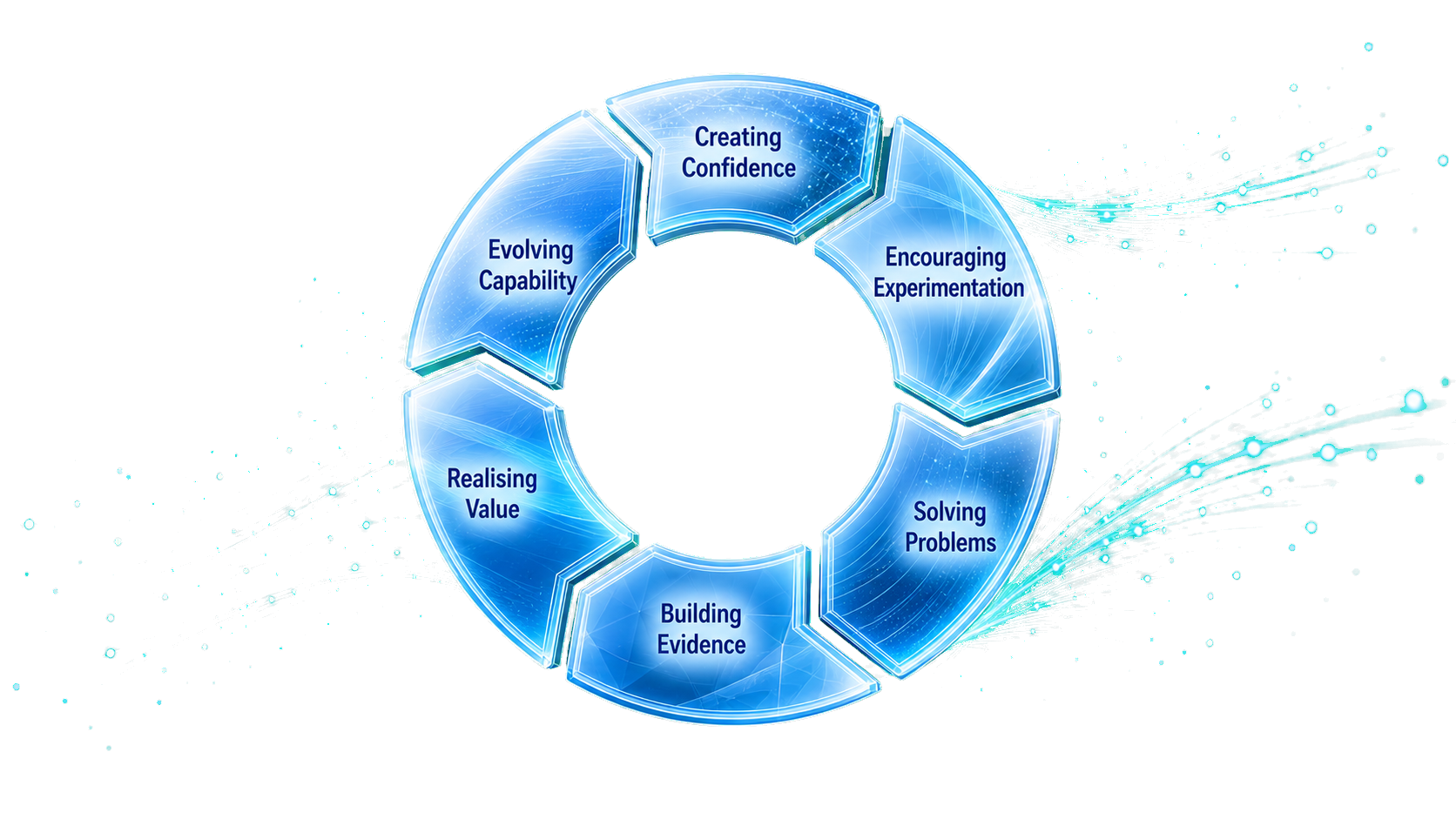
1. creating confidence
People build confidence through experience, not presentations.
We help your people apply AI to relevant aspects of their work, explore what is possible and understand where human judgement still matters. This gives them the practical confidence to question existing approaches and recognise opportunities for improvement.
2. encouraging experimentation
Confidence only creates value when people have permission to use it.
We help organisations create the space, support and proportionate guardrails people need to experiment safely. Instead of experimentation happening informally around the edges of work, it becomes a purposeful way to explore problems, test assumptions and learn.
Governance supports experimentation from the beginning rather than appearing as a final barrier once an idea has already been developed.
3. solving problems
Useful AI ideas rarely begin with the technology. They begin with real work.
We help teams identify friction, delay, repetition, quality problems and missed opportunities. They can then explore how AI might improve the way the work is performed, keeping the intended outcome, not the novelty of the tool, at the centre.
This turns people from passive users of AI into active problem-solvers.
4. building evidence
A promising demonstration creates interest. Credible evidence creates the confidence to act.
Teams define what they expect an experiment to improve and gather proportionate evidence of what changed. This moves the conversation beyond enthusiasm, anecdotes and estimated hours saved.
Saving time can be valuable, but only when it changes an outcome. Has capacity increased? Has quality improved? Has risk reduced? Are customers or employees having a better experience? Can the organisation now do something it could not do before?
Building Evidence is the bridge between human and organisational capability. It helps leaders decide which ideas should progress, which need refining and which should stop.
5. realising value
An experiment has not created lasting value simply because it makes a task faster.
Value is realised when a proven idea improves a meaningful outcome and becomes a trusted part of how work gets done. That may mean greater capacity, better quality, lower risk, a stronger employee or customer experience, faster decisions or an entirely new capability.
We help organisations embed successful ideas into the surrounding processes, responsibilities, controls and measures. Individual discoveries become sustainable operational improvements that can be trusted, shared and repeated.
6. evolving capability
The return from a successful AI experiment is larger than its immediate outcome.
It also leaves people more confident, leaders better informed and the organisation better equipped to recognise and realise the next opportunity. Experience becomes reusable knowledge. Evidence improves future decisions. Successful approaches provide foundations that other teams can build upon.
This is how capability compounds. Instead of repeatedly starting from scratch, the organisation becomes progressively better at creating value from AI.
measure outcomes, not activity
Training completed, licences deployed and people using AI can indicate activity. They do not tell you whether anything has become better.
Capability to Value™ looks for observable changes in:
- Time and capacity
- Cost and productivity
- Quality and accuracy
- Customer and employee experience
- Risk and control
- Decision-making
- The ability to perform new work
- Organisational learning and reusable capability
The evidence should be proportionate to the decision. It does not need to become a heavyweight business case, but it must be credible enough to show what changed and what the organisation should do next.
build organisational momentum
Capability to Value™ is a cycle, not a one-off programme or maturity ladder.
Every pass through the framework creates practical experience, evidence, better ways of working and organisational learning. That learning strengthens the next cycle and helps people recognise new opportunities more quickly and confidently.
We call this Organisational Momentum.
Like a flywheel, every successful improvement stores energy:
- People become more confident
- Valuable ideas become easier to recognise
- Evidence supports better decisions
- Trusted approaches can be reused
- Organisational knowledge grows
- The next opportunity becomes easier to realise