
The new Financial Services Skills Compact asks firms to upskill their workforce in AI and other critical skills over a rolling three-year period.
Making the commitment is one thing. Turning it into meaningful learning that fits real roles, normal working hours and operational pressures is another.
this is bigger than a training target
Published on 14 July 2026, the Financial Services Skills Compact asks signatories to make four commitments:
- Upskill their workforce in AI and other critical skills.
- Maintain or grow structured routes for new talent.
- Give a senior executive responsibility for closing skills gaps.
- Publish annual progress updates.
For AI learning, the scale is significant. Firms must identify their critical skills and report the number and percentage of UK employees they have upskilled.
But the Compact is not asking firms to accumulate training hours or roll out another generic mandatory course.
In fact, its definition excludes mandatory training. Learning should be intentionally selected, show clear evidence of engagement and completion, and be meaningful in its effort and impact. It is also expected to take place during normal working hours.
That creates a very practical challenge for financial services leaders:
How do you provide relevant AI learning across a diverse workforce without taking people away from important work for hours at a time?
short does not have to mean superficial
Traditional learning programmes often force organisations to choose between two imperfect options.
A lengthy course may offer depth, but it can be difficult to fit around customer operations, regulatory responsibilities and daily delivery. A short e-learning course is easier to distribute, but may do little to change how people work.
There is another option: short, facilitated learning built around the decisions, risks and activities people encounter in their roles.
This is the thinking behind the Modulearn Financial Services AI learning pathway.
Its focused modules typically run for between 30 and 90 minutes. Rather than asking people to passively consume generic AI content, participants work through practical scenarios, discuss the implications and identify how to apply the learning safely within their own environment.
one workforce does not mean one learning experience
The Compact is workforce-wide, but AI capability is not identical across every role.
A customer service team needs to understand how AI can support clearer communication without compromising customer trust. Compliance professionals need to explore governance, confidentiality and human oversight. Payments teams need scenarios grounded in exceptions, alerts and investigations.
The Modulearn pathway reflects those differences:
- AI for Humans provides an accessible foundation in working effectively with AI.
- Intelligent Service explores AI-supported customer operations, including drafting and interaction summaries.
- Adaptive Risk & Compliance examines policy analysis, control reviews, governance and human oversight.
- Smart Payments applies AI to payment exceptions, alert triage and financial crime investigations.
- Augmented Markets explores faster research, market insight and client briefing preparation.
The pathway also includes practical modules covering AI-assisted decision-making, experimentation and solution-finding. Together, they allow firms to combine a common foundation with learning relevant to particular functions.
from completion to capability
The Compact measures unique learners rather than the number of courses or hours completed. Signatories are also encouraged to explain how their learning was meaningful, what capability it developed and what business impact followed.
That makes the learning design important.
A completion record can show that somebody attended. It cannot, by itself, show that they understand when to rely on AI, when to question it or how to apply it appropriately in their work.
Modulearn sessions finish with practical actions, supported by follow-up reviews that help participants reflect on what they tried and what happened next. This can help firms move beyond recording participation towards gathering evidence of learning in practice.
Modulearn is not a substitute for the governance, measurement and reporting firms need around the Compact. It is a practical delivery option within that wider learning plan.
where does your plan stand?
The Financial Services Skills Compact gives the sector a clear direction. The immediate challenge is translating that direction into learning that is relevant, manageable and capable of changing everyday behaviour.
Short, facilitated and role-specific modules can help firms begin that work without waiting for a large transformation programme.
The real question is no longer whether financial services firms need to build AI capability.
It is whether their current learning plan can deliver it across the workforce.
How does your AI skills plan measure up?
Benchmark your learning plan against the Financial Services Skills Compact in five clicks.
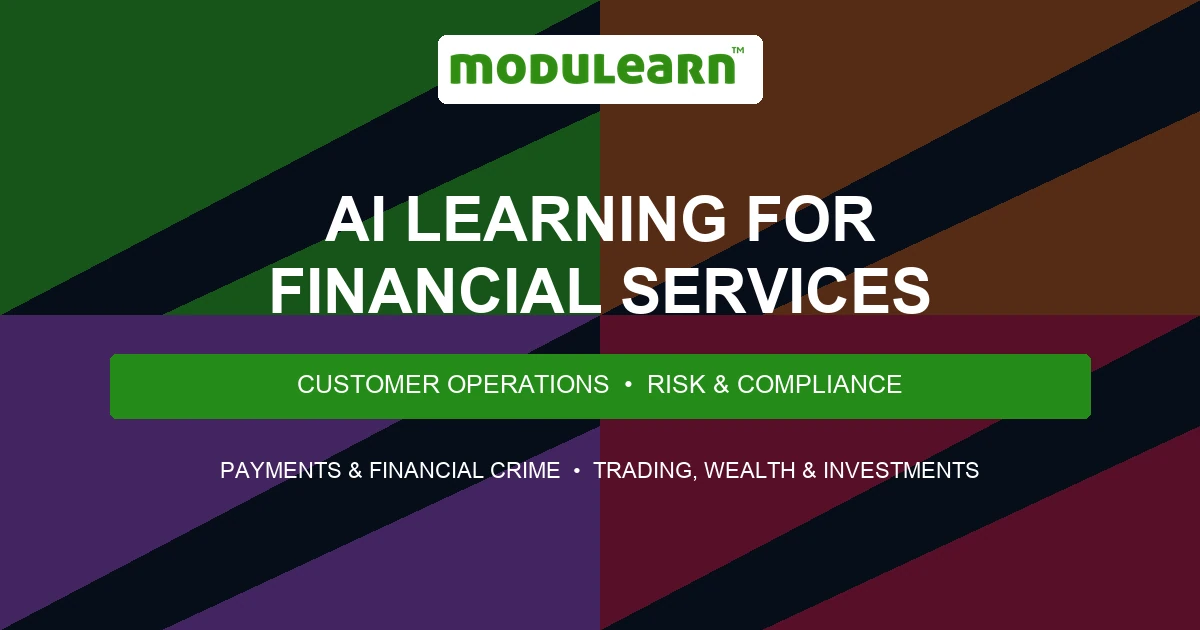
Financial Services Learning Pathway
Explore short, facilitated learning built around real financial services scenarios and learning paths.